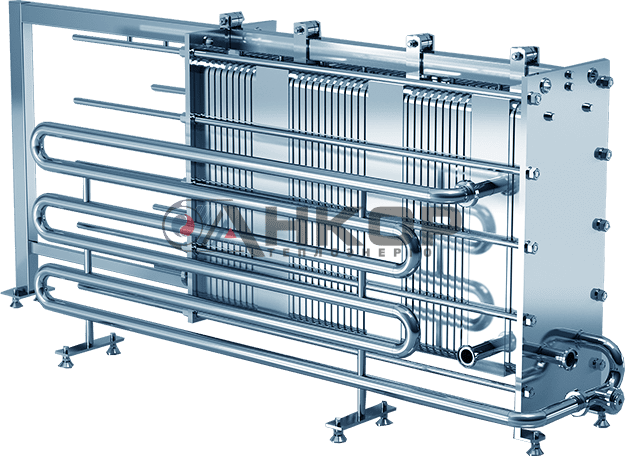
Plate pasteurizers are devices used for the thermal processing of liquid products such as dairy products, juices, beer, and other beverages in order to extend their shelf life by destroying pathogenic microorganisms. The pasteurization process involves briefly heating the product to a specific temperature that is high enough to kill most microorganisms but does not significantly alter the taste or nutritional value of the product. After that, the liquid is rapidly cooled to a temperature at which it can be safely stored.
The main working element of a plate pasteurizer is a plate heat exchanger, which is a set of thin metal plates stacked into a pack. Between the plates, channels are formed through which two flows pass: the processed liquid and the heat transfer medium. The plates are arranged in such a way that intensive heat exchange occurs between adjacent channels: the product is heated when in contact with the hot heat transfer medium and then cooled in a section where cold water flows. The large heat transfer surface area provided by the high number of plates and narrow channels ensures high heat transfer efficiency, which significantly reduces pasteurization time and improves process efficiency.
Plate pasteurizers are widely used in the food industry due to their compact size, energy efficiency, and the ability to easily adjust process parameters. Their design also facilitates cleaning and maintenance, making them preferable in production environments where frequent product changeovers are required.
Advantages of plate pasteurizers compared to other types of pasteurizers
Plate pasteurizers have a number of significant advantages compared to other types of pasteurizers, such as tubular and immersion systems. First of all, they provide high heat transfer efficiency due to their design, consisting of multiple thin metal plates with a large heat transfer surface area. This allows for faster heating and cooling of the product, reducing pasteurization time and energy consumption.
One of the key advantages of plate pasteurizers is their compactness. Compared to tubular pasteurizers, they occupy less space at the same capacity, making them convenient for use in production facilities with limited space. The design of plate systems also simplifies maintenance and cleaning. The plates can be easily disassembled for mechanical cleaning or flushing, which is important in the food industry where hygiene requirements are high.
These pasteurizers also offer operational flexibility, allowing easy adjustment of the number of plates to increase or decrease capacity, as well as enabling multi-stage processing where different sections of the unit heat and cool the product in several stages. This makes them versatile for various production processes and product types.
In addition, plate pasteurizers have better energy efficiency due to heat recovery: during the cooling stage, the incoming cold product is preheated by the heat of the already heated product, which reduces heating and cooling costs. This advantage is especially valuable in large-scale production, where energy savings directly affect production costs.
Compared to immersion or tank pasteurizers, which require large amounts of heat transfer medium and longer processing times, plate systems are more economical and process products faster while maintaining product quality and nutritional properties.
Key factors when selecting a plate pasteurizer
When selecting a plate pasteurizer, several key factors must be considered, as they directly affect its performance, efficiency, and suitability for specific production requirements.
Capacity and throughput. The first important aspect is the rated capacity of the pasteurizer and its ability to process the required volume of product per unit of time. Production capacity depends on processing speed and the number of plates in the unit. You should choose a pasteurizer that matches your production volume to avoid overloading or underutilization of equipment.
Temperature parameters and holding time. Different products require specific pasteurization temperature regimes and holding times. When selecting a pasteurizer, it is important to ensure that it can maintain the required temperature range and provide sufficient residence time for microorganism destruction.
Plate material and hygiene requirements. Plates are usually made of stainless steel, as this material is corrosion-resistant and easy to clean. In the food industry, hygiene standards are especially important, so attention must be paid to material quality and compliance with standards such as ISO and FDA. Anti-corrosion properties are particularly important when working with aggressive liquids or acidic juices.
Energy efficiency and heat recovery. One of the important factors is the unit’s ability to recover heat. A high level of heat recovery reduces energy consumption, as during cooling the heat is transferred to the incoming product, preheating it. This significantly reduces heating and cooling costs.
Flexibility and modular design. It is beneficial if the pasteurizer has the ability to increase capacity or change configuration depending on future production needs. Modular designs allow adding or removing plates to adjust capacity, which is useful for production expansion or product changes.
Ease of cleaning and maintenance. Plate pasteurizers should be easy to disassemble for mechanical cleaning and regular maintenance. This is especially important in the food industry, where strict cleanliness and sanitation standards require frequent equipment cleaning.
Considering these factors, it is possible to select a plate pasteurizer that best fits specific production needs, ensuring high product quality, cost efficiency, and operational reliability.
Operation and maintenance
Operation and maintenance of plate pasteurizers are key aspects that directly affect their efficiency, durability, and hygienic performance in production processes. Proper operation ensures stable equipment performance, while regular maintenance helps prevent breakdowns, extend service life, and maintain high product quality.
Operation
Start-up and setup. Before starting the pasteurizer, it is important to ensure that all components, such as pumps, valves, and heat transfer systems, are functioning correctly. Temperature and holding time settings must match product requirements. During initial operation, the system should run several cycles to verify stable performance.
Temperature and pressure control. Continuous monitoring of pasteurization temperature and system pressure is essential. If the temperature drops below the required level, pasteurization may be ineffective, leading to the risk of surviving microorganisms. System pressure must also be controlled to prevent leaks and damage.
Heat recovery cycle. It is important to monitor the efficiency of the heat recovery system, which preheats the incoming product using heat from the already pasteurized product. This reduces energy costs but requires proper operation of all pasteurizer sections.
Cleaning between batches. Depending on the product type and production regulations, plate pasteurizers may require cleaning between production cycles, especially when switching between different products (for example, from milk to juice). This prevents contamination and maintains product safety.
Maintenance
Regular cleaning (CIP). Plate pasteurizers require regular Cleaning in Place (CIP). This process involves flushing internal components with cleaning solutions (alkaline and acidic detergents) that remove organic and mineral deposits without disassembling the equipment. Cleaning is especially important for removing residues that accumulate in narrow plate channels.
Inspection and replacement of seals. Gaskets used between plates are subject to wear due to temperature and mechanical stress. Regular inspection and replacement are necessary, as worn seals can cause leaks and reduce heat exchange efficiency.
Plate inspection. Plates must be regularly inspected for wear, corrosion, or deformation. Even minor damage can reduce pasteurization efficiency or cause cross-contamination. In case of significant damage, plates must be replaced.
Pump and valve checks. Pumps and valves controlling product and heat transfer medium flow must be in good working condition. Faulty pumps can cause uneven distribution of liquid across plates, disrupting the pasteurization process.
System performance monitoring. Regular analysis of energy consumption, heat recovery efficiency, and temperature stability should be performed. Any deviation may indicate the need for maintenance or system upgrades.
Preventive maintenance. In addition to scheduled cleaning and replacement of worn parts, preventive maintenance should include full system inspection, replacement of working fluids, and verification of automation systems.
Periodic full maintenance, including complete disassembly for detailed inspection, can be performed every few months depending on usage intensity. This approach minimizes the risk of failures caused by wear or contamination buildup.
To maintain hygiene standards and prevent product contamination, pasteurizers must comply with strict sanitation regulations. It is important to keep plate surfaces clean and prevent deposit and bacterial buildup in heat exchange channels.
Thus, effective operation and regular maintenance of plate pasteurizers play a crucial role in ensuring their performance, efficiency, and food product safety.